

Key Takeaways
- FinTech startup ideas continue to outperform traditional digital products, as users increasingly rely on mobile-first solutions for payments, banking, investing, and money management, creating sustained demand for innovative fintech app ideas.
- The most successful finance app ideas solve real, recurring problems, such as instant payments, automated savings, personalized budgeting, and frictionless digital banking—making banking app ideas one of the most scalable opportunities in 2026.
- Modern fintech app ideas are built on AI, APIs, and cloud-native architectures, enabling startups to launch faster, scale securely, and adapt quickly to regulatory and market changes.
- User experience, security, and compliance are non-negotiable factors in finance app ideas, as trust directly influences adoption, retention, and long-term profitability.
- Startups that focus on niche-driven fintech app ideas, rather than generic financial tools, are better positioned to compete with established financial institutions and attract both users and investors.
FinTech has evolved from a niche innovation into a core pillar of the global financial system. From digital payments and mobile banking to AI-driven lending and wealth management, financial technology is reshaping how individuals and businesses interact with money. What was once dominated by traditional banks is now being led by agile, technology-first companies that prioritize speed, transparency, and user experience.
This shift has created an unprecedented opportunity for entrepreneurs and investors. Fintech startup ideas are gaining traction because they solve real, everyday problems—high transaction fees, slow cross-border payments, limited access to credit, and poor financial visibility. As consumers increasingly expect financial services to be available instantly, securely, and on mobile devices, the demand for innovative finance startup ideas continues to grow across global markets.
What sets successful fintech ventures apart today is scalability. Modern fintech businesses are built on cloud-native architectures, API-driven ecosystems, and data intelligence, allowing them to grow rapidly without linear cost increases. The most promising fintech business ideas combine strong compliance foundations with automation, personalization, and seamless user experiences—making them attractive not only to users but also to long-term investors.
In this article, we explore some of the most viable and future-ready fintech startup ideas, examining where the real opportunities lie and how founders can turn financial innovation into sustainable, high-growth businesses.
Market Reality Check: Why FinTech Startups Still Win
Before exploring specific fintech startup ideas, it is important to address a fundamental question many founders and investors still ask: Is FinTech still a viable and profitable space to build in?
The short answer is yes—and the long answer lies in how the market, user behavior, and technology adoption have evolved over the past few years.
This section establishes the real-world context behind FinTech’s continued dominance and explains why trends that emerged during the fintech startup 2021 phase remain highly relevant today.
Growth of Digital Finance
Digital finance is no longer an emerging category—it is now a core part of the global economic infrastructure. Over the last decade, financial services have moved decisively from branch-based and paperwork-heavy systems to digital-first platforms powered by APIs, cloud computing, and automation.
What began as simple mobile payment apps has evolved into full-scale ecosystems that support banking, lending, investing, insurance, compliance, and wealth management. Many of today’s top fintech startups are not merely competing with traditional banks; they are becoming the underlying infrastructure that banks and enterprises rely on.
This sustained growth demonstrates that FinTech is not a speculative trend. It is a structurally embedded industry with long-term demand driven by efficiency, transparency, and accessibility.
Consumer Behavior Shift Toward Digital-First Finance
One of the strongest reasons FinTech startups continue to succeed is the permanent shift in consumer behavior. Users now expect financial services to be:
- Available 24/7
- Mobile-first and intuitive
- Personalized using data and analytics
- Secure by design
Consumers no longer compare a banking or finance app to another bank—they compare it to the best digital experiences they use daily. This expectation has created space for startups to innovate faster than traditional institutions.
The success of platforms that emerged during the fintech startup 2021 era showed that once users experience frictionless digital finance, they rarely return to legacy systems. This behavioral change continues to create opportunities for new fintech startup ideas that improve speed, clarity, and control over money.
The Role of Mobile-First Finance
Mobile-first design is no longer optional in FinTech—it is foundational. Smartphones have become the primary interface for managing money, from payments and budgeting to investing and borrowing.
This shift explains why many fintech startup ideas 2021 that focused on mobile apps are still relevant today. The difference now is maturity: modern users expect smarter interfaces, deeper insights, and seamless integrations rather than just basic functionality.
Mobile-first finance enables startups to:
- Reach underserved and global audiences
- Launch faster with lean infrastructure
- Continuously iterate based on real-time user data
As mobile adoption continues to grow worldwide, finance apps built with a mobile-first mindset remain among the most scalable and resilient business models in the FinTech ecosystem.
Why FinTech Startup 2021 Trends Still Matter Today
Many of the ideas that gained traction during the fintech startup 2021 wave—such as digital wallets, neobanks, P2P payments, and personal finance tools—have not lost relevance. Instead, they have evolved.
What has changed is not the core idea, but the sophistication of execution. Today’s successful startups build on those early concepts by adding:
- AI-driven personalization
- Embedded finance capabilities
- Stronger compliance and security layers
- Data-driven decision engines
The fact that several top fintech startups today originated from concepts validated in earlier years proves a key point: FinTech rewards iteration and depth, not constant reinvention. Founders who understand why past trends worked are better positioned to refine them into scalable, future-ready products.
Core Technologies Powering Modern FinTech Apps
Understanding how FinTech products are built is just as important as identifying the right idea. Many blogs list fintech startup ideas without explaining the technical foundation behind them, which often leads to shallow analysis. In reality, the success of modern FinTech products depends heavily on the technology stack that supports scalability, security, compliance, and continuous innovation.
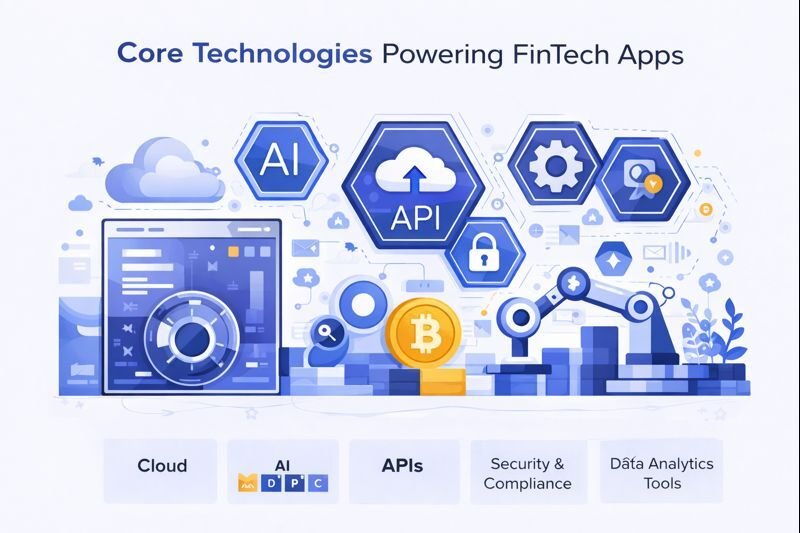
This section highlights the core technologies that define today’s fintech app solutions and explains why they are critical to long-term product viability.
AI & Automation
Artificial intelligence has become a cornerstone of modern financial application development. From fraud detection and credit scoring to customer support and predictive analytics, AI enables FinTech apps to operate faster, smarter, and more accurately than traditional systems.
Automation reduces manual intervention in processes such as transaction monitoring, compliance checks, loan approvals, and portfolio management. This not only improves operational efficiency but also minimizes human error—an essential factor in regulated financial environments.
For startups, AI-driven automation allows small teams to scale rapidly while delivering enterprise-grade functionality, making it a decisive advantage in competitive FinTech markets.
Cloud-Native Finance Platforms
Cloud-native architecture is the backbone of scalable FinTech applications. Modern financial application development relies on cloud platforms to ensure high availability, elastic scaling, and global reach.
Cloud-native finance platforms enable:
- Rapid deployment and iteration
- Cost-efficient infrastructure management
- Seamless updates and feature rollouts
- Built-in disaster recovery and redundancy
By adopting cloud-native systems, FinTech startups can support millions of users and transactions without the limitations of on-premise infrastructure. This flexibility is one of the reasons cloud adoption is a standard practice among companies offering fintech app development services.
API-Driven Ecosystems
APIs are the connective tissue of the FinTech ecosystem. Payment gateways, banking services, identity verification tools, credit bureaus, and analytics platforms all communicate through secure APIs.
An API-driven approach allows FinTech startups to:
- Integrate third-party financial services quickly
- Build modular and extensible products
- Enable embedded finance use cases
- Launch faster without reinventing core financial components
This ecosystem-based model has reshaped how fintech app solutions are designed, making collaboration and interoperability key drivers of innovation and speed to market.
Security & Compliance
Security and regulatory compliance are non-negotiable in FinTech. Financial applications handle sensitive data, real-time transactions, and personal identity information, making them prime targets for cyber threats.
Modern financial application development incorporates:
- End-to-end encryption
- Tokenization of sensitive data
- Secure authentication mechanisms
- Continuous compliance monitoring
Regulatory frameworks vary across regions, but successful FinTech apps are built with compliance embedded into their architecture from day one. This approach reduces risk, builds user trust, and ensures smoother market expansion.
For startups partnering with providers of fintech app development services, security and compliance readiness often determine how quickly a product can scale across markets.
In essence, the most successful FinTech startups are not defined solely by innovative ideas, but by the strength of the technology foundations beneath them. AI, cloud-native platforms, APIs, and robust security frameworks together enable FinTech products to remain agile, compliant, and resilient in an increasingly complex financial landscape.
This technical groundwork sets the stage for exploring specific fintech startup ideas that can be transformed into scalable, real-world applications.
7. Top FinTech Startup Ideas to Build in 2026
With the FinTech market entering a phase of maturity and consolidation, not every idea has the potential to scale or generate sustainable revenue. The fintech startup ideas outlined below are selected based on three clear criteria: scalability, monetization potential, and real market demand. These ideas are already validated by user behavior and industry adoption, yet still leave room for innovation through better execution, technology, and user experience.
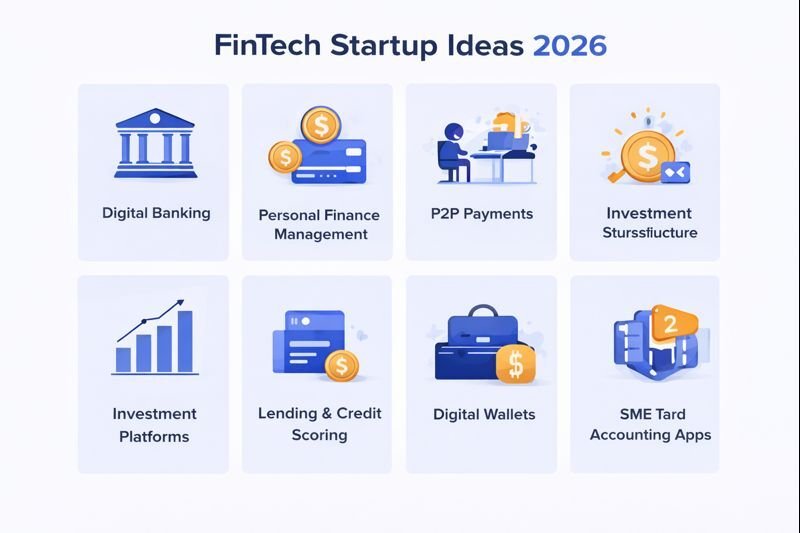
Each idea represents a practical opportunity to build finance applications that align with modern expectations of speed, intelligence, and accessibility.
Digital Banking App
Digital banking remains one of the most impactful banking app ideas in the FinTech ecosystem. These applications provide users with end-to-end banking services—account management, payments, savings, and financial insights—without the need for physical branches.
What it solves:
Digital banking apps eliminate friction associated with traditional banking, such as long processing times, limited access, and complex user journeys.
Why users want it:
Users prefer apps that offer real-time access to their finances, transparent fee structures, and intuitive interfaces. Mobile-first digital banks meet these expectations efficiently.
Monetization model:
Revenue is typically generated through subscription plans, interchange fees, premium features, and partnerships. This makes digital banking one of the most reliable finance app ideas for long-term growth.
Personal Finance Management App
Personal finance management tools continue to be among the most in-demand personal finance app ideas, particularly as users become more conscious of budgeting, savings, and financial planning.
Budgeting and expense tracking:
These apps help users categorize spending, track income, and set financial goals in real time.
AI-driven insights:
Advanced applications use AI to analyze spending behavior and offer personalized recommendations, alerts, and forecasts.
For founders exploring finance app ideas for startups, personal finance apps offer strong engagement, recurring usage, and multiple monetization opportunities through subscriptions and premium analytics.
P2P Payment App
Peer-to-peer payment platforms are foundational fintech app ideas that enable instant money transfers between individuals and businesses.
Instant transfers:
Users can send and receive money in real time, reducing reliance on cash or traditional bank transfers.
Wallet integrations:
Modern P2P apps integrate with digital wallets, cards, and bank accounts, creating a seamless payment experience.
These fintech application ideas scale rapidly due to network effects and typically monetize through transaction fees, merchant services, and value-added financial products.
Investment & Wealth Management App
Investment platforms are evolving into intelligent wealth ecosystems, making them some of the most promising fintech business ideas in 2026.
Robo-advisors:
Automated investment engines provide portfolio management based on user goals, risk profiles, and market conditions.
Micro-investing:
Low entry barriers allow users to invest small amounts regularly, increasing accessibility and adoption.
For entrepreneurs seeking sustainable finance startup ideas, investment apps offer high lifetime value through asset-based fees and premium advisory services.
Lending & Credit Scoring App
Digital lending platforms remain central ideas for fintech startups, especially in regions with limited access to traditional credit.
Alternative credit models:
These apps evaluate creditworthiness using non-traditional data such as transaction history, behavioral patterns, and mobile usage.
AI underwriting:
Machine learning models improve loan approval speed while reducing default risk.
Lending apps monetize through interest margins, processing fees, and partnerships with financial institutions.
Digital Wallet App
Digital wallets are a core part of the cashless economy and continue to rank among the most scalable finance app startup ideas.
Cashless ecosystem:
Wallets enable users to store funds, make payments, and manage loyalty programs in one place.
Embedded finance:
Wallets increasingly serve as gateways for lending, insurance, and investment services.
Monetization includes transaction fees, merchant services, and cross-selling financial products.
InsurTech App
InsurTech applications modernize insurance by simplifying policy management and claims processing.
Policy comparison:
Users can compare coverage options transparently and select plans tailored to their needs.
Claims automation:
AI-driven claims handling reduces processing time and improves customer satisfaction.
InsurTech platforms generate revenue through commissions, subscriptions, and insurer partnerships.
Expense & Accounting App for SMEs
Small and medium-sized businesses require efficient tools for managing finances, making accounting apps a strong B2B opportunity.
Business finance management:
These apps track expenses, cash flow, and tax obligations in real time.
Invoice automation:
Automated invoicing and reconciliation reduce manual work and errors.
SME-focused finance apps often operate on subscription-based models with high retention rates.
Embedded Finance for Non-Financial Apps
Embedded finance allows non-financial platforms to offer payments, lending, or insurance directly within their ecosystems.
APIs for payments and lending:
Businesses integrate financial services without becoming regulated financial institutions.
B2B monetization:
Revenue is generated through revenue sharing, transaction fees, and platform partnerships.
This model has become a cornerstone of scalable fintech ecosystems.
AI Financial Copilot App
AI financial copilots represent the next evolution of ios finance app ideas and intelligent financial tools.
Predictive insights:
These apps analyze financial data to forecast cash flow, spending, and investment outcomes.
Smart recommendations:
Users receive real-time guidance for budgeting, investing, and risk management.
As advanced fintech app ideas, financial copilots monetize through subscriptions and enterprise licensing while delivering high user value.
Collectively, these fintech startup ideas reflect where the market is headed: intelligent, user-centric, and deeply integrated financial experiences. Each idea can be adapted across regions and platforms, offering founders multiple paths to innovation and growth in 2026 and beyond.
How to Choose the Right FinTech App Idea
Having a list of promising fintech startup ideas is only the first step. The real challenge lies in selecting an idea that is viable, defensible, and attractive to investors. In a competitive and regulated industry like FinTech, success depends less on novelty and more on strategic alignment with market realities.
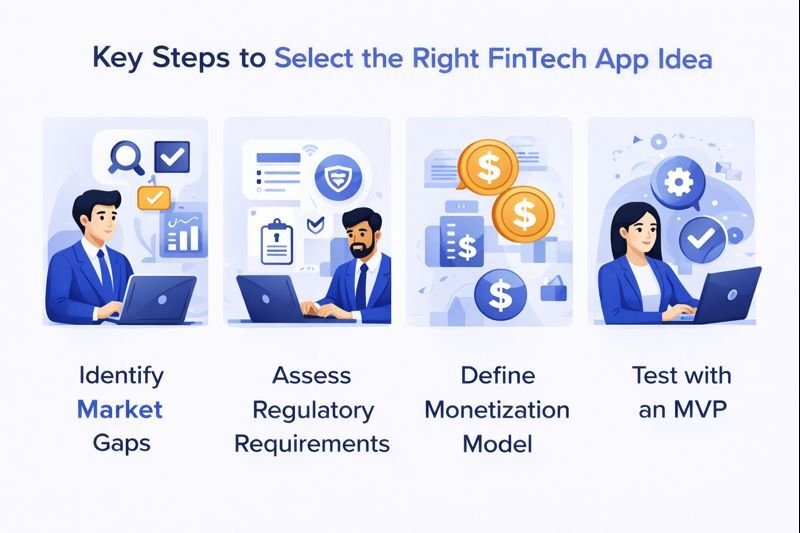
This section provides practical, investor-focused guidance to help founders evaluate and refine their fintech app ideas before committing significant resources.
Identifying Market Gaps
The strongest FinTech startups are built around clearly defined, measurable problems. Rather than competing directly with large, established platforms, successful founders identify gaps where users remain underserved or dissatisfied.
To uncover these gaps:
- Analyze user friction in existing finance apps
- Study customer reviews and feature limitations
- Look for inefficiencies in cross-border payments, lending access, or financial visibility
A strong market gap is one where demand is proven, but solutions remain fragmented or overly complex. Ideas rooted in real user pain points are far more likely to achieve early adoption and long-term relevance.
Regulatory Readiness
Regulation is one of the defining characteristics of FinTech. An idea that appears profitable but ignores compliance requirements can fail before it reaches scale.
Before finalizing a fintech app idea, founders must assess:
- Licensing and jurisdictional requirements
- Data protection and privacy laws
- KYC, AML, and transaction monitoring obligations
Investor confidence increases significantly when regulatory considerations are built into the product strategy from the beginning. Regulatory readiness not only reduces risk but also accelerates expansion into new markets.
Monetization Clarity
Many finance apps fail not because users do not engage, but because revenue models are unclear or unsustainable. A strong fintech idea should have monetization built into its core value proposition.
Common monetization approaches include:
- Subscription-based access
- Transaction or service fees
- API licensing or white-label offerings
- Revenue-sharing partnerships
Founders should be able to clearly explain how the product generates revenue, how it scales with user growth, and how pricing aligns with perceived value. Monetization clarity is a critical factor for investor evaluation.
MVP Feasibility
A successful FinTech startup does not begin with a fully developed product—it starts with a focused, testable MVP. MVP feasibility ensures that the idea can be validated quickly without excessive cost or complexity.
Key questions to assess include:
- Can core features be built within a realistic timeline?
- Is the technology stack mature and accessible?
- Can compliance and security be addressed at MVP stage?
An MVP that solves a single problem exceptionally well provides valuable user feedback, supports fundraising efforts, and reduces the risk of overbuilding.
9. Monetization Models for FinTech Startups
A compelling product alone does not guarantee success in FinTech. Long-term sustainability depends on how effectively a platform converts usage into revenue. The most successful fintech business ideas are built around monetization models that scale alongside user adoption while maintaining trust and transparency.
Below are the most proven revenue models used by high-growth finance startup ideas in today’s FinTech ecosystem.
Subscription-Based Model
Subscription pricing is one of the most reliable monetization strategies for FinTech platforms that deliver continuous value. Users pay a recurring fee in exchange for access to premium features, advanced analytics, automation, or personalized financial insights.
This model works particularly well for:
- Personal finance management apps
- Investment and wealth management platforms
- AI-powered financial copilots
Subscription-based monetization offers predictable revenue, strong user retention, and higher lifetime value—key metrics investors look for when evaluating fintech business ideas.
Transaction Fees
Transaction-based monetization remains a core revenue driver for many FinTech platforms. In this model, startups earn a small fee each time a financial action is performed.
Common examples include:
- Payment processing fees
- Money transfer fees
- Trading or exchange fees
- Lending origination or servicing fees
This approach scales naturally with volume, making it ideal for finance startup ideas focused on payments, wallets, P2P transfers, and trading platforms. When implemented transparently, transaction fees maintain user trust while generating consistent revenue.
API Licensing
API licensing has emerged as a powerful monetization strategy, especially for B2B-focused fintech business ideas. Instead of selling directly to end users, startups license their infrastructure or services to other companies.
Examples include:
- Payment APIs
- Identity verification services
- Credit scoring engines
- Compliance and reporting tools
This model enables startups to generate recurring B2B revenue, reduce customer acquisition costs, and build long-term enterprise partnerships.
Partnerships & Commissions
Strategic partnerships allow FinTech startups to monetize by connecting users with third-party financial products and services. Revenue is earned through commissions or revenue-sharing agreements.
Common partnership-based models include:
- Insurance policy referrals
- Investment product distribution
- Lending partnerships with banks or NBFCs
- Merchant and affiliate programs
For many finance startup ideas, partnerships provide a low-risk path to monetization while expanding service offerings without significant infrastructure investment.
Role of Professional Financial App Developers
While a strong idea and business model are essential, execution ultimately determines the success of any FinTech product. Financial applications operate in a highly regulated, security-sensitive environment, where technical missteps can lead to compliance failures, data breaches, or loss of user trust. This is why many successful startups rely on experienced financial app developers rather than attempting to build complex systems in isolation.
This section explains the strategic value of professional development teams without turning the discussion into a sales pitch.
Why FinTech Apps Need Experts
FinTech applications are fundamentally different from standard consumer apps. They must handle real money, sensitive data, and mission-critical transactions in real time. Experienced financial app developers bring a deep understanding of financial workflows, system reliability, and performance optimization.
Expert teams help founders:
- Avoid costly architectural mistakes
- Select scalable and compliant technology stacks
- Accelerate development timelines with proven frameworks
- Build products that are production-ready from day one
This expertise is especially important for startups aiming to move quickly from MVP to enterprise-grade platforms.
Compliance & Security as a Core Discipline
Compliance and security are not features that can be added later—they must be embedded into the foundation of financial app development. Professional development teams understand regulatory requirements such as data protection, identity verification, and transaction monitoring across different markets.
By integrating security practices like encryption, secure authentication, and continuous monitoring, experienced developers reduce risk and ensure that FinTech products meet regulatory expectations from the start. This approach not only protects users but also builds confidence among partners and investors.
Scalability & User Experience
A FinTech app that cannot scale smoothly or deliver a reliable user experience will struggle to retain users. Professional fintech app development companies design systems with scalability in mind, using modular architectures and cloud-native infrastructure to support growth.
At the same time, they prioritize user experience by creating intuitive interfaces that simplify complex financial processes. A balance between technical robustness and usability is essential for driving adoption and long-term engagement.
Challenges in Building FinTech Apps
Building a FinTech application offers significant opportunity, but it also comes with a unique set of challenges that founders must address early. Acknowledging these challenges openly not only builds credibility with readers but also helps set realistic expectations for entrepreneurs and investors evaluating fintech startup ideas.
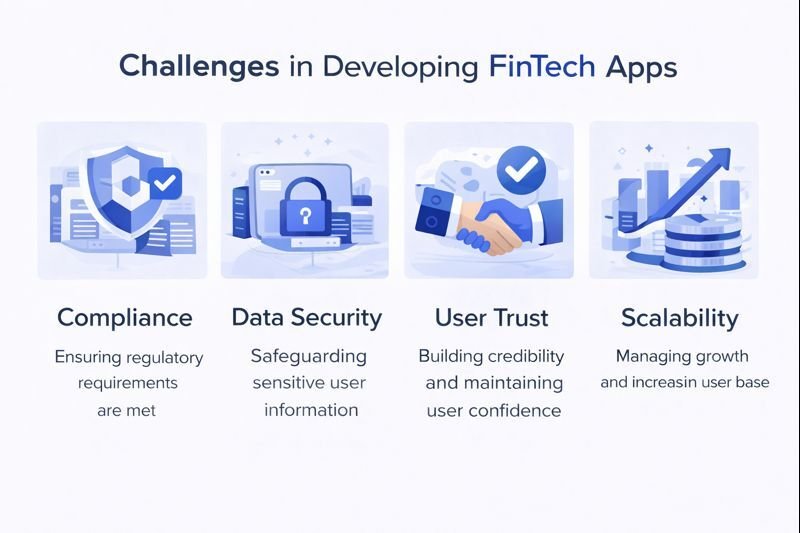
Understanding these risks—and planning for them—can significantly increase the chances of long-term success.
Compliance & Regulation
Regulatory compliance is one of the most complex aspects of building FinTech products. Financial applications must operate within strict legal frameworks that vary by country and region. Requirements around licensing, KYC, AML, data protection, and reporting are constantly evolving.
Failing to meet regulatory standards can result in delayed launches, fines, or forced shutdowns. Successful FinTech startups proactively design compliance into their systems, rather than treating it as a post-launch requirement. Early consultation with legal and regulatory experts is often as important as technical planning.
Data Security
FinTech platforms handle highly sensitive personal and financial data, making security a top priority. Cyber threats targeting financial applications continue to grow in sophistication, and a single breach can permanently damage user trust.
Key security challenges include:
- Protecting transaction data
- Securing user identities
- Preventing fraud and unauthorized access
- Ensuring safe data storage and transmission
Strong encryption, secure authentication, and continuous monitoring are essential components of any FinTech security strategy.
User Trust
Trust is the foundation of every successful financial product. Users need to feel confident that their money and data are safe and that the platform operates transparently.
Building trust requires:
- Clear communication around fees and policies
- Reliable system performance
- Transparent data usage practices
- Responsive customer support
Even technically sound products can fail if users perceive them as unreliable or opaque. Trust is earned through consistent, high-quality user experiences over time.
Scaling Infrastructure
Many FinTech startups struggle when early traction turns into rapid growth. Systems that work well for a small user base may fail under high transaction volumes if scalability was not planned from the beginning.
Challenges related to scaling include:
- Managing peak transaction loads
- Maintaining performance across regions
- Ensuring system availability and uptime
- Controlling infrastructure costs
Scalable, cloud-native architecture and proactive performance testing help startups prepare for growth without compromising reliability.
Future of FinTech App Innovation
The FinTech industry continues to evolve at a rapid pace, driven by advances in artificial intelligence, data science, and platform-based ecosystems. For founders and investors, understanding where innovation is headed is essential for building products that remain relevant beyond initial launch. This section explores the key forces shaping the future of FinTech app development and provides a forward-looking perspective that future-proofs fintech startup ideas.
Agentic AI
Agentic AI represents the next phase of artificial intelligence in financial applications. Unlike traditional models that respond to predefined inputs, agentic AI systems can make independent decisions, learn continuously, and act proactively within defined constraints.
In FinTech, agentic AI is expected to:
- Automate complex financial decision-making
- Optimize lending, investment, and risk management processes
- Adapt to market conditions in real time
These systems will reduce manual intervention while improving accuracy and speed, enabling financial platforms to operate with greater efficiency and resilience.
Embedded Finance Everywhere
Embedded finance is moving beyond payments to become a foundational layer across digital platforms. Financial services such as lending, insurance, and investments are increasingly being integrated directly into non-financial applications.
This shift allows businesses in retail, logistics, travel, and SaaS to offer seamless financial experiences within existing user journeys. For FinTech innovators, embedded finance opens new B2B opportunities and recurring revenue models by positioning financial capabilities as modular, API-driven services.
Hyper-Personalization
As data analytics and AI capabilities mature, FinTech apps are becoming more personalized than ever. Hyper-personalization enables platforms to tailor financial products, insights, and recommendations to individual user behavior, preferences, and goals.
Examples include:
- Dynamic budgeting suggestions
- Personalized investment strategies
- Context-aware credit offers
This level of customization improves user engagement, trust, and long-term retention—key success factors for modern FinTech applications.
Autonomous Financial Systems
The future of FinTech points toward autonomous financial systems that can manage transactions, optimize portfolios, and maintain compliance with minimal human oversight.
These systems combine AI, automation, and real-time data processing to:
- Execute financial operations independently
- Monitor risks continuously
- Adjust strategies based on evolving conditions
While human oversight remains essential, autonomous systems will significantly reduce operational complexity and enable financial platforms to scale more efficiently.
Conclusion
FinTech continues to stand at the intersection of innovation, regulation, and real-world impact. As the industry matures, the opportunities for building successful products remain strong—but they are increasingly shaped by execution quality rather than novelty alone.
The most promising fintech startup ideas in 2026 are those grounded in genuine user needs, supported by robust technology, and designed with long-term scalability in mind. Whether the focus is on digital banking, payments, lending, or intelligent financial management, the fundamentals remain consistent: clear value delivery, strong security practices, and resilient system architecture.
For founders evaluating finance app ideas, the path forward requires more than identifying trends. It demands thoughtful validation, regulatory awareness, and disciplined product development. Similarly, successful fintech app ideas are not built overnight—they evolve through continuous learning, user feedback, and strategic iteration.
Ultimately, FinTech success comes down to aligning the right idea with the right execution. Startups that prioritize user trust, operational reliability, and future readiness are best positioned to build platforms that not only launch successfully, but continue to grow and compete in an increasingly sophisticated financial ecosystem.
FAQs
Q1. What are the best fintech startup ideas?
The best fintech startup ideas are those that solve clear financial problems while offering scalability and strong monetization potential. Popular categories include digital banking apps, personal finance management tools, P2P payment platforms, lending and credit scoring solutions, investment and wealth management apps, and embedded finance platforms. The most successful ideas combine user convenience, regulatory readiness, and intelligent use of technology.
Q2. How do fintech apps make money?
Fintech apps generate revenue through several proven models, including subscription plans, transaction fees, API licensing, and partnerships or commissions. Many high-growth fintech platforms use a hybrid approach, combining multiple revenue streams to reduce dependency on a single source and improve long-term sustainability.
Q3. How much does it cost to build a fintech app?
The cost of building a fintech app depends on factors such as feature complexity, compliance requirements, security standards, and platform choice (iOS, Android, or web). A basic MVP may require a lower initial investment, while enterprise-grade applications with advanced security, AI features, and multi-region compliance involve higher development costs. Planning a phased rollout often helps manage budgets effectively.
Q4. What technologies are used in fintech app development?
Modern fintech app development relies on a combination of technologies, including cloud-native infrastructure, APIs, artificial intelligence, machine learning, and advanced security frameworks. Programming languages, cloud platforms, data analytics tools, and automation systems work together to create secure, scalable, and high-performing financial applications.

Pingback: Top 10 Fintech App Development Firms in New York