
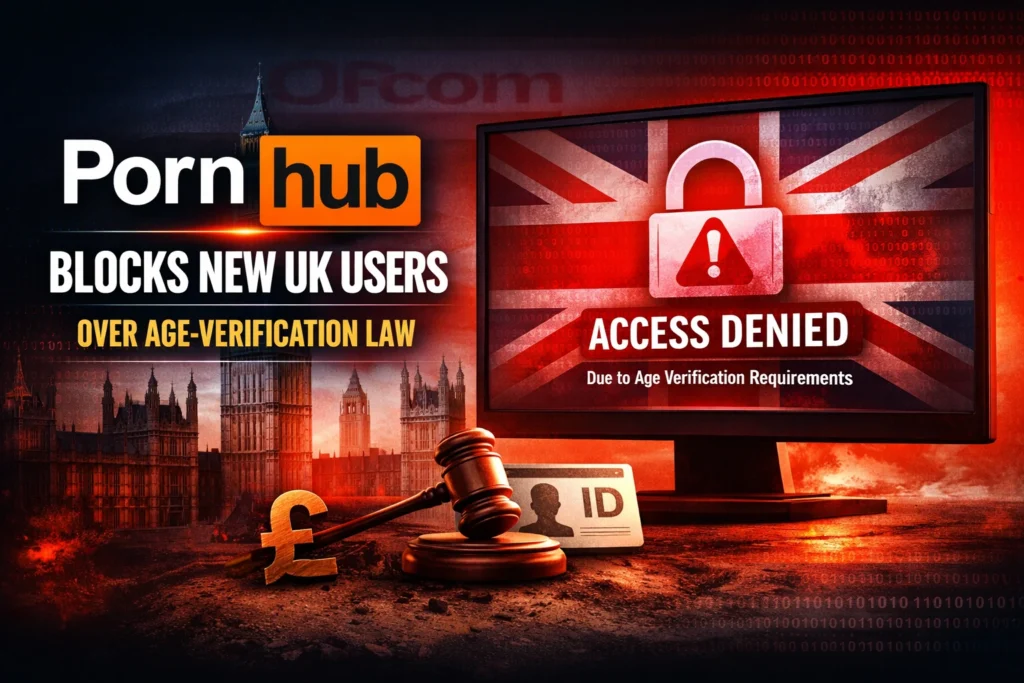
Pornhub has officially begun blocking new users in the United Kingdom following a regulatory dispute over the country’s strict age-verification requirements under the Online Safety Act.
As of February 2, 2026, new visitors attempting to access the platform from UK IP addresses are met with a restriction notice instead of the usual homepage. The change applies only to new users. Existing UK users who had previously completed age verification before the deadline continue to retain access.
The restriction also affects sister platforms YouPorn and RedTube, which are operated by Pornhub’s parent company, Aylo.
What Led to the Block?
The move follows enforcement of the UK’s Online Safety Act, a sweeping regulatory framework designed to strengthen online child safety protections.
The law, overseen by Ofcom, requires adult-content platforms to implement what regulators describe as “highly effective” age-assurance systems.
Approved verification methods include:
-
Government-issued ID verification
-
Facial age estimation technology
-
Credit card age checks
-
Mobile network operator verification
Platforms that fail to comply face penalties of up to £18 million or 10% of global annual turnover, whichever is higher. Ofcom also holds the authority to pursue ISP-level blocking of non-compliant services.
Why Pornhub Opposes the Framework
Aylo has publicly criticized the current age-verification system, arguing that it is flawed in both design and outcome.
According to company statements, the concerns include:
1. Significant Traffic Decline
Following the introduction of mandatory age checks in 2025, Pornhub reported a sharp drop in UK traffic. Company executives argue that instead of reducing access to adult content, the rules may be redirecting users toward unregulated offshore websites that ignore compliance standards.
2. Privacy and Data Security Concerns
Age verification under the Act often requires users to upload government IDs or submit biometric scans through third-party providers.
Critics say this creates a new layer of cybersecurity risk. Large-scale storage of identity data raises concerns about potential data breaches and long-term surveillance implications.
This has shifted the debate beyond content moderation to broader issues of digital privacy and identity governance.
3. Competitive Imbalance
Aylo has suggested that large, compliant platforms bear heavy regulatory costs, while smaller or foreign-operated websites may evade enforcement — creating uneven market conditions.
By blocking new UK users rather than exiting entirely, the company appears to be balancing regulatory compliance with public opposition to the framework.
Ofcom’s Position
Ofcom maintains that protecting minors online is a priority and that platforms must either comply with the law or cease providing services in the UK.
Regulators have launched investigations into multiple adult websites to ensure consistent enforcement. Officials have stated that the responsibility lies with platforms to implement robust safeguards.
While discussions around device-level age verification — where age is confirmed once at the device level rather than per site — have emerged, current legislation requires site-level compliance.
Broader Impact on the Digital Landscape
The situation has sparked renewed debate over the balance between child protection and personal privacy.
Key implications include:
-
Increased use of VPN services to bypass geo-restrictions
-
Rising demand for privacy-preserving age-verification technology
-
Global scrutiny from governments considering similar legislation
The UK’s enforcement model is being closely watched by regulators worldwide. If the framework proves effective, it could become a template for future digital safety laws. If it primarily drives users toward unregulated platforms, lawmakers may face pressure to revise the approach.
A Defining Moment for Internet Regulation
Pornhub’s restriction of new UK users marks one of the most visible confrontations between a major global platform and a national online safety regime.
The development highlights a new era in digital governance — where regulatory mandates directly influence access, user growth, and business strategy.
As the Online Safety Act continues to unfold, its long-term effects on privacy, platform accountability, and global internet regulation remain under close observation.