
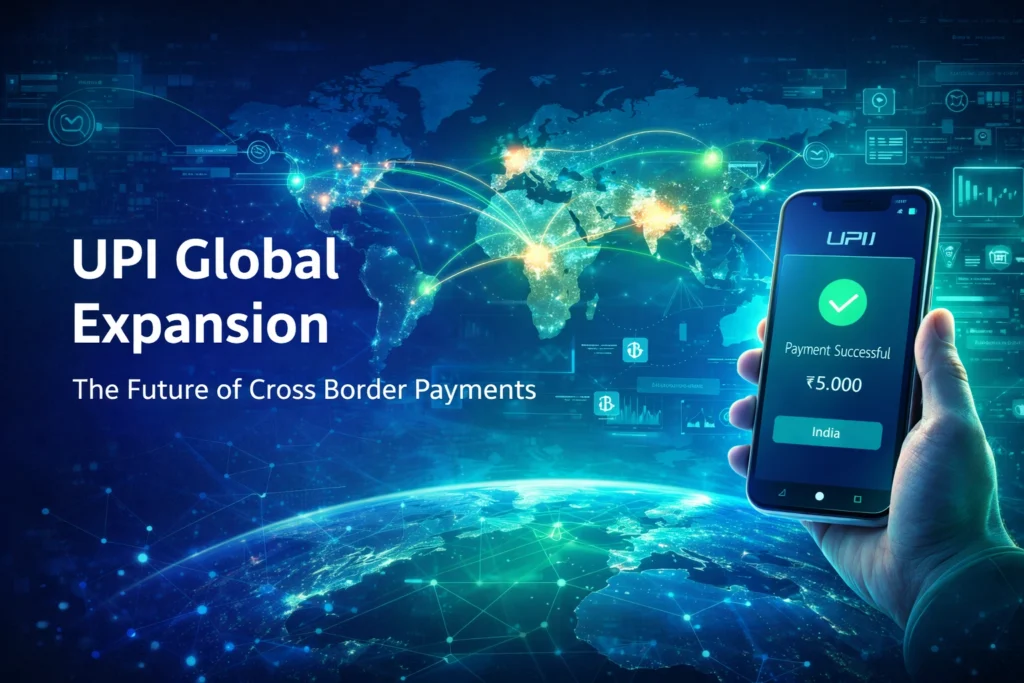
Key Takeaways
- India Stack is evolving into a global digital public infrastructure model
- Unified Payments Interface is transforming cross border payments with real time settlements
- Traditional systems like SWIFT face disruption due to faster and cheaper alternatives
- Integration of blockchain and CBDCs is reshaping global financial architecture
- Digital first nations are adopting UPI inspired models for scalable financial inclusion
The Rise of India Stack as a Global Financial Infrastructure
Over the past decade, India has quietly built one of the most advanced digital ecosystems in the world. What started as a national initiative has now become a global benchmark.
India Stack, a collection of digital public infrastructure layers including identity, payments, and data exchange, is no longer limited to domestic use. It is now being studied and adopted by multiple countries seeking to modernize their financial systems.
At the center of this transformation is UPI, which has redefined how individuals and businesses transact.
UPI Global Expansion and Its Impact on Cross Border Payments
The expansion of UPI beyond India marks a significant turning point in the global payments landscape.
Countries across Asia, the Middle East, and Europe are exploring or already integrating UPI rails into their financial ecosystems. This shift enables seamless cross border payments without relying heavily on traditional intermediaries.
For users, this means:
- Instant transactions across borders
- Lower transaction costs
- Simplified payment experiences
For businesses, it unlocks faster settlements, improved cash flow, and reduced operational complexity.
Why Traditional Systems Are Losing Ground
Legacy financial networks such as SWIFT have long dominated cross border payments. However, they are increasingly challenged by modern payment infrastructures.
Key Limitations of Traditional Systems
- Settlement delays that can take days
- High transaction fees due to multiple intermediaries
- Lack of transparency in processing
In contrast, UPI driven systems offer near real time settlement and significantly lower costs.
This shift is forcing global financial institutions to rethink their infrastructure strategies.
The End of FX Friction in Global Transactions
One of the biggest advantages of UPI global expansion is the reduction of foreign exchange friction.
Traditional cross border payments often involve hidden charges and unfavorable exchange rates. With UPI based integrations, transactions are becoming more transparent and efficient.
This benefits:
- International travelers
- Exporters and small businesses
- Freelancers working across borders
As adoption increases, the cost of moving money globally is expected to decline significantly.
Real Time Payments Are Becoming the Global Standard
Speed is no longer optional in financial transactions. It is an expectation.
The shift from delayed settlements to real time processing is redefining user experience and business efficiency.
UPI has demonstrated that real time payments can be:
- Scalable
- Secure
- Cost effective
As more countries adopt similar systems, real time cross border payments will become the norm rather than the exception.
The New Financial Technology Stack
The future of global payments is not driven by a single technology. It is powered by the convergence of multiple innovations.
UPI Rails
Provide the foundation for instant transactions.
Blockchain
Enhances transparency and security.
CBDCs
Enable government backed digital currencies for seamless transactions.
This combination is creating a new financial stack that is faster, more reliable, and globally interoperable.
Opportunities for Fintech Companies
The globalization of UPI presents massive opportunities for fintech companies.
Product Innovation
Fintechs can build solutions on top of UPI infrastructure for payments, lending, and financial services.
Market Expansion
Companies can enter new markets with lower barriers.
Cost Optimization
Reduced dependency on traditional banking systems lowers operational costs.
For fintech startups, this is a chance to compete with established players by leveraging modern infrastructure.
Challenges in Global Adoption
Despite its advantages, the global adoption of UPI and India Stack comes with challenges.
Regulatory Differences
Each country has its own financial regulations.
Infrastructure Compatibility
Integration with existing systems can be complex.
Data Security Concerns
Ensuring privacy and compliance is critical.
Standardization Issues
Achieving interoperability across countries requires coordination.
Addressing these challenges will be key to scaling UPI globally.
How Digital First Nations Are Leading the Shift
Countries with strong digital infrastructure are leading the adoption of UPI inspired systems.
These nations are bypassing legacy systems and building modern financial ecosystems from the ground up.
This approach enables:
- Faster innovation
- Greater financial inclusion
- Improved economic efficiency
India’s success with UPI serves as a blueprint for these nations.
The Future of Cross Border Payments
The next decade will redefine how money moves globally.
Key trends to watch:
- Increased adoption of real time payment systems
- Integration of CBDCs into mainstream finance
- Decline of intermediary heavy systems
- Growth of decentralized financial networks
UPI and India Stack are at the center of this transformation.
Final Thoughts
The globalization of UPI is not just a technological advancement. It represents a fundamental shift in the financial ecosystem.
By enabling faster, cheaper, and more transparent transactions, it is setting new standards for global payments.
For businesses, fintech companies, and financial institutions, the question is no longer whether this transformation will happen. It is how quickly they can adapt.
India Stack has moved beyond being a national innovation. It is now shaping the future of global finance.
Frequently Asked Questions
What is India Stack
India Stack is a set of digital public infrastructure layers that enable identity, payments, and data exchange.
What is UPI and how does it work
UPI is a real time payment system that allows instant money transfers between bank accounts.
How does UPI impact cross border payments
It enables faster, cheaper, and more transparent transactions across countries.
Can UPI replace SWIFT
While it may not fully replace it immediately, it is emerging as a strong alternative for certain use cases.
What are CBDCs and how do they relate to UPI
CBDCs are digital currencies issued by governments and can integrate with payment systems like UPI for seamless transactions.