Key Takeaways
- Decentralized exchanges remove custodial risk by allowing users to trade directly from their wallets.
- Enterprise DEX platforms focus on transparency, compliance adaptability, and scalable liquidity models.
- Development cost ranges from $60,000 to $400,000+, depending on architecture and governance depth.
- ROI comes from trading fees, liquidity incentives, white-label licensing, and infrastructure reuse.
- Long-term success depends more on liquidity design and security governance than UI alone.
Why Decentralized Exchange Development Is Gaining Enterprise Attention
Decentralized exchanges are no longer experimental products limited to crypto-native communities. They are increasingly evaluated by enterprises as infrastructure-level trading systems that reduce counterparty risk, automate settlement, and improve audit transparency.
Unlike centralized exchanges, a DEX eliminates asset custody by the platform operator. This shift aligns well with institutional priorities around operational resilience, asset control, and programmable compliance.
Market leaders such as Uniswap demonstrate how automated liquidity and smart contracts can support billions in daily volume without centralized intermediaries, reinforcing enterprise confidence in decentralized models.
How a Decentralized Exchange Actually Works
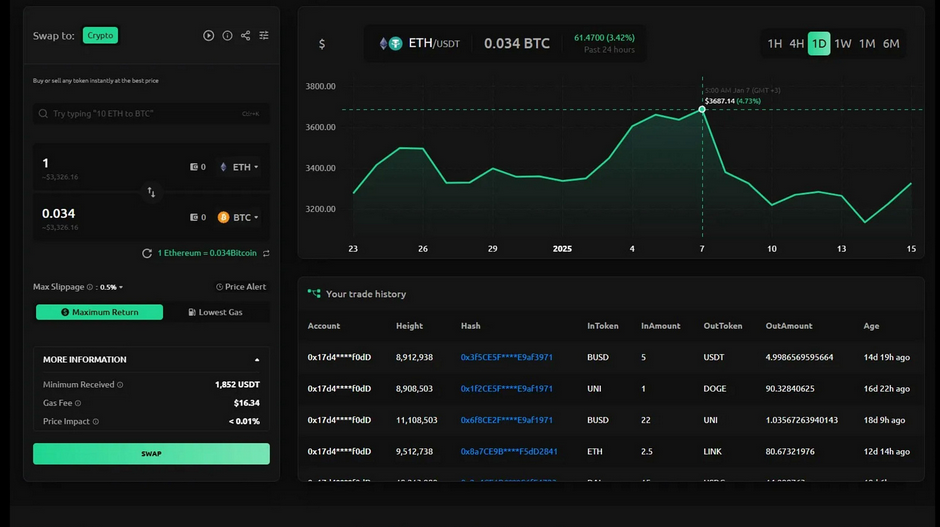
A decentralized exchange operates through smart contracts deployed on a blockchain network.
Instead of depositing funds into an exchange wallet:
- Users connect their own wallets
- Trades execute directly on-chain
- Settlement is automatic and verifiable
Liquidity is provided through pools or counterparties, and pricing adjusts algorithmically or through order matching logic. Every transaction is recorded on the blockchain, allowing independent verification.
This structure is what makes decentralized crypto exchange development attractive for organizations prioritizing transparency and reduced custodial exposure.
Core Types of Decentralized Exchanges
Automated Market Maker (AMM)
Uses liquidity pools and pricing formulas. Best for scalable, always-on markets.
Order Book DEX
Matches buy and sell orders on-chain or via hybrid models. Preferred by institutions familiar with traditional trading systems.
Hybrid DEX
Off-chain matching with on-chain settlement. Balances performance with custody protection.
RFQ-Based DEX
Request-for-Quote systems optimized for large trades and predictable pricing.
DEX Aggregators
Route trades across multiple platforms to optimize execution quality.
Each model impacts liquidity behavior, latency, and compliance complexity.
Key Benefits of a Decentralized Exchange Platform
User-Controlled Custody
In a decentralized exchange, users retain ownership of their digital assets at all times. Funds remain in personal wallets and are never transferred to a central platform for storage. Trades are executed directly through smart contracts, which removes reliance on an intermediary to safeguard assets. This structure significantly lowers the risk associated with hacks, internal misuse, or insolvency of the exchange operator.
Elimination of Single Points of Failure
Traditional trading platforms depend on centralized servers and custody systems, making them vulnerable to outages or targeted attacks. A decentralized exchange distributes its operations across a blockchain network, reducing dependence on any single system or authority. Even if one component faces disruption, the overall trading infrastructure continues to function, improving reliability and resilience.
Transparent Settlement and Auditability
Every transaction executed on a decentralized exchange is recorded on the blockchain, creating a permanent and verifiable record. This allows participants to independently confirm trade execution, pricing logic, and settlement outcomes without relying on internal reports. Such transparency strengthens trust among users and supports governance, compliance reviews, and system audits.
Global Market Access
Decentralized exchanges are accessible to users worldwide without requiring centralized onboarding processes or regional infrastructure. Anyone with a compatible wallet and internet connection can participate, regardless of location. This open access expands market reach, increases liquidity potential, and supports cross-border trading without traditional geographic limitations.
Lower Infrastructure Dependency
DEX platforms rely primarily on smart contracts and blockchain networks rather than large centralized server environments. Once deployed, the system requires fewer operational resources to maintain core trading functions. This reduces long-term infrastructure overhead and simplifies scaling compared to centralized platforms that must manage extensive backend systems.
Faster Asset Listing Cycles
New digital assets can be introduced through smart contract configuration or liquidity pool creation rather than lengthy approval and custody processes. This enables quicker market entry for emerging tokens and allows platforms to adapt faster to changing market demand. For enterprises, this flexibility supports innovation without extensive operational delays.
Enterprise Impact
Taken together, these advantages reduce operational exposure, improve system transparency, and strengthen user confidence. For enterprises, decentralized exchanges offer a trading infrastructure that is more resilient, easier to audit, and aligned with modern risk management expectations. Over time, this leads to stronger system trust and more sustainable platform growth.
Essential Features in Enterprise-Grade DEX Development
- Smart contract–based trade execution
- Cross-chain asset support
- Liquidity pool management tools
- Secure wallet integrations
- Oracle-based pricing feeds
- Monitoring and analytics dashboards
- Upgradeable contract governance
- Compliance reporting layers
These features ensure long-term stability as volumes and regulatory expectations evolve.
Steps to Develop a Decentralized Exchange Platform
Requirement and Market Analysis
This stage focuses on understanding who the exchange is for and how it will be used. Teams define target users, supported assets, trading volume expectations, and regulatory constraints. Clear requirements at this stage prevent costly redesigns later.
DEX Model Selection
The exchange architecture is chosen based on liquidity needs and performance goals. Options such as AMM, order-book, hybrid, or RFQ models determine how trades are matched, priced, and settled, directly shaping scalability and user experience.
Smart Contract Engineering and Audits
Core trading logic, liquidity handling, and governance rules are written into smart contracts. These contracts undergo extensive testing and third-party audits to reduce security risks, as flaws at this level can lead to irreversible losses.
Frontend and Backend Integration
User interfaces are connected to on-chain contracts through secure backend services. This layer manages wallet interactions, transaction routing, analytics, and system monitoring while keeping the trading flow smooth and reliable.
Liquidity and Oracle Setup
Liquidity mechanisms are implemented to ensure efficient trading, while price oracles provide accurate market data. Reliable liquidity and trustworthy pricing are essential to prevent slippage, manipulation, and execution errors.
Testnet Validation
Before launch, the platform is deployed on a test network to simulate real trading conditions. This phase helps identify bugs, performance bottlenecks, and security gaps without risking real assets.
Mainnet Deployment
After successful testing, the exchange is launched on the main blockchain network. Smart contracts are finalized, liquidity is activated, and real users begin trading under live conditions.
Monitoring, Upgrades, and Governance
Post-launch, continuous monitoring ensures stability and security. Governance frameworks allow controlled upgrades, parameter adjustments, and long-term evolution without disrupting user trust.
Cost to Build a Decentralized Exchange
Typical Cost Range
- Basic DEX: $60,000 – $120,000
- Mid-Scale Platform: $150,000 – $350,000
- Enterprise-Grade DEX: $400,000+
Cost Drivers
- Architecture type
- Number of supported chains
- Security audit depth
- Liquidity tooling
- Compliance integrations
Cost control often comes from phased releases and modular system design.
Maximizing ROI From Decentralized Exchange Development
Revenue Streams
- Trading fees
- Liquidity incentives
- Staking mechanisms
- White-label deployments
- Infrastructure licensing
Strategic ROI
- Stronger user trust
- Market differentiation
- Reduced operational overhead
- Reusable blockchain infrastructure
Tracking liquidity growth, active wallets, and transaction volume is key to measuring ROI.
Challenges in Decentralized Exchange Development
Liquidity Constraints
Without sufficient liquidity, trades can face high slippage and poor execution. This limits user adoption and reduces overall trading activity on the platform.
Smart Contract Security Risks
DEXs rely entirely on smart contracts, making vulnerabilities a critical threat. Even small coding errors can lead to fund loss or protocol exploitation.
Scalability and Network Performance
As transaction volume increases, on-chain execution can become slow and expensive. Congestion and high fees negatively impact the trading experience.
User Experience Barriers
Complex interfaces and technical onboarding requirements can discourage non-technical users, slowing platform growth.
Interoperability Limitations
DEXs operating on a single blockchain may struggle to attract diverse assets and users, reducing competitiveness in multi-chain ecosystems.
Frequently Asked Questions
How long does DEX development take?
10–14 weeks for MVPs; 4–8 months for enterprise platforms.
Which industries benefit most from DEX platforms?
Financial services, tokenized assets, gaming economies, and supply chain networks.
How is security ensured?
Through audits, formal verification, controlled upgrades, and continuous monitoring.