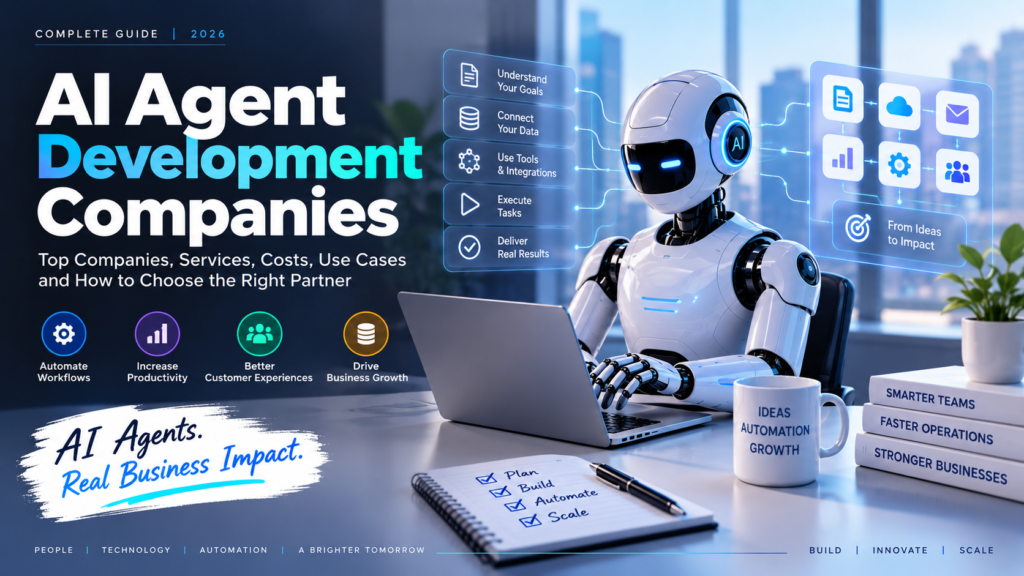
AI agent development companies are helping businesses move beyond traditional chatbots and basic automation toward AI systems that can understand goals, reason through tasks, use business data, interact with software, and complete multi-step workflows with limited human intervention.
But choosing an AI agent development company is becoming increasingly difficult.
Almost every software development company now offers “AI agents.” The real difference is whether a provider can build an agent that works reliably in a production environment—not simply create an impressive demo.
This guide explains what AI agent development companies do, what services they provide, how much AI agent development can cost, what technologies are commonly used, and the companies businesses can consider in 2026.
What Are the Best AI Agent Development Companies?
There is no single AI agent development company that is the right fit for every business.
Different providers specialize in different types of projects, including enterprise AI, custom AI products, workflow automation, conversational agents, data-intensive agents, customer service automation, and AI-powered business applications.
Companies worth researching in 2026 include:
| Company | Areas to Consider |
|---|---|
| LeewayHertz | Enterprise AI, custom AI agents, generative AI |
| Markovate | AI products, AI agents, MVP development |
| InData Labs | Data-intensive AI, machine learning, AI agents |
| SoluLab | AI development, automation, enterprise solutions |
| Maruti Techlabs | AI development, automation, enterprise software |
| ValueCoders | AI development and software engineering |
| Kellton | Enterprise technology and AI solutions |
| SoftServe | Enterprise AI, data engineering and digital transformation |
| EPAM | Enterprise engineering, AI and digital transformation |
| Thoughtworks | AI engineering, technology strategy and enterprise systems |
The right provider depends on your use case, required integrations, security requirements, budget, timeline, and whether you need an AI prototype or a production-ready agent.
What Is an AI Agent?
An AI agent is a software system that can interpret a goal, determine what actions are required, use tools or data, execute those actions, evaluate the results, and continue working until the task is completed or human intervention is required.
A traditional chatbot might answer:
“Your order is delayed.”
An AI agent could potentially:
- Identify the customer.
- Retrieve the order.
- Check shipment status.
- Contact the logistics API.
- Determine the reason for the delay.
- Check company policies.
- Offer an appropriate resolution.
- Update the CRM.
- Send the customer a message.
- Escalate the case if the situation falls outside its permissions.
That difference is important.
Chatbots primarily respond. AI agents can execute workflows.
Why Businesses Are Investing in AI Agents in 2026
The AI market is moving from experimentation toward systems that can actually perform business tasks.
Recent developments show the shift toward agentic software across software engineering, customer service, enterprise operations and other workflows. For example, Salesforce has been expanding its Agentforce ecosystem, while AI-agent companies focused on software engineering are attracting significant investment.
AI agents can potentially help businesses:
- Automate repetitive workflows
- Reduce manual data entry
- Improve customer support
- Qualify leads automatically
- Process documents
- Analyze large datasets
- Assist sales teams
- Automate internal IT operations
- Coordinate multiple software systems
- Support employees with company-specific knowledge
- Monitor business processes
- Execute approved actions automatically
The important point is that an AI agent should be connected to a real business workflow.
An AI agent that simply produces text is usually less valuable than an agent that can safely perform a useful business task.
What Do AI Agent Development Companies Do?
A professional AI agent development company can handle much more than connecting an LLM to a chatbot interface.
Typical services include:
1. Custom AI Agent Development
Companies can build AI agents specifically for a business process.
Examples include:
- Customer support agents
- Sales agents
- Lead qualification agents
- Research agents
- Finance agents
- HR agents
- Healthcare workflow agents
- IT support agents
- E-commerce agents
- Procurement agents
- Document-processing agents
- Coding agents
2. AI Chatbot Development
Modern AI chatbots can use company knowledge bases, databases and external tools.
Instead of simply answering predefined questions, an AI chatbot can potentially:
- Search company information
- Retrieve customer records
- Create support tickets
- Check order status
- Schedule appointments
- Generate reports
- Escalate complex requests
3. Multi-Agent Systems
Some business processes require multiple specialized agents.
For example:
Research Agent → Analysis Agent → Verification Agent → Report Agent
Each agent can have a specific responsibility while an orchestration layer coordinates the overall workflow.
This approach can be useful for complex processes where one general-purpose agent would become difficult to control.
4. AI Agent Integration
AI agents become much more useful when they can interact with existing software.
Development teams may integrate agents with:
- CRM systems
- ERP platforms
- Payment systems
- Databases
- APIs
- Customer support platforms
- Communication tools
- Cloud services
- Internal business applications
This is where agent development becomes a genuine software engineering problem rather than simply an LLM implementation.
AI Agent Development Companies to Consider in 2026
Instead of presenting an arbitrary “number one to number ten” ranking, businesses should compare companies according to their project requirements.
1. LeewayHertz
LeewayHertz is an AI and software development company that works on enterprise AI, generative AI and custom software solutions.
Businesses researching AI agent development can consider the company for projects involving custom AI applications, enterprise systems and AI-powered workflows.
Consider it for: enterprise AI, custom AI applications and complex software projects.
2. Markovate
Markovate focuses on AI-powered products, generative AI and custom software development.
Its positioning can make it relevant for companies looking to develop an AI product or transform an existing product with intelligent functionality.
Consider it for: AI products, custom AI applications and MVP development.
3. InData Labs
InData Labs works across artificial intelligence, machine learning, data science and software development.
Its data-focused background can be relevant for AI agents that need to work with large amounts of structured or unstructured business information.
Consider it for: data-heavy AI applications, machine learning and intelligent analytics.
4. SoluLab
SoluLab provides software development and AI development services across multiple industries.
Businesses can evaluate SoluLab for AI applications, automation and custom software projects where AI needs to be integrated into an existing technology environment.
Consider it for: AI development, automation and custom software.
5. Maruti Techlabs
Maruti Techlabs works across software engineering, artificial intelligence, automation and enterprise technology.
Its combination of software development and AI capabilities can be relevant for businesses looking to integrate AI into operational workflows.
Consider it for: enterprise automation, AI software and custom development.
6. ValueCoders
ValueCoders provides software development and engineering services, including AI-related development.
It can be considered by businesses looking for development resources for AI applications, automation and software engineering projects.
Consider it for: software development, AI implementation and engineering support.
7. Kellton
Kellton is an enterprise technology company working across digital transformation, software and emerging technologies.
For larger organizations, an enterprise technology provider can be useful when AI agents need to work alongside existing business systems and digital infrastructure.
Consider it for: enterprise transformation and large-scale technology projects.
8. SoftServe
SoftServe operates across software engineering, cloud, data and artificial intelligence.
Its broader engineering capabilities can be relevant for organizations that need AI agents integrated into existing enterprise technology environments.
Consider it for: enterprise AI, data engineering and digital transformation.
9. EPAM
EPAM provides large-scale software engineering and digital transformation services, including artificial intelligence capabilities.
Its enterprise engineering background can be relevant for organizations requiring complex integrations, security requirements and large technology programs.
Consider it for: enterprise engineering, AI transformation and complex software ecosystems.
10. Thoughtworks
Thoughtworks is a technology consultancy known for software engineering, digital transformation and technology strategy.
For organizations exploring AI agents, its engineering-focused approach can be relevant when agentic AI needs to be incorporated into broader software architecture.
Consider it for: AI engineering, enterprise architecture and digital transformation.
How to Choose an AI Agent Development Company
The biggest mistake businesses make is choosing a vendor based only on a website’s AI claims.
Instead, evaluate the development company using the following criteria.
1. Production Experience
Ask:
- Have they deployed AI agents in production?
- Can they show relevant case studies?
- What happens when the agent makes a mistake?
- How is agent performance monitored?
A polished demo does not necessarily demonstrate production readiness.
2. Agent Architecture
Ask the development company what architecture they recommend.
Depending on the use case, the solution may include:
- LLMs
- Retrieval-augmented generation
- Tool calling
- Workflow orchestration
- Memory
- Vector databases
- APIs
- Agent frameworks
- Evaluation systems
- Human approval workflows
The architecture should be designed around the business problem rather than around a fashionable framework.
3. Integration Capability
A useful AI agent usually needs access to business systems.
Ask whether the provider can integrate with:
- Salesforce
- HubSpot
- SAP
- Microsoft Dynamics
- Shopify
- Custom APIs
- SQL databases
- Cloud platforms
- Internal applications
4. Security and Permissions
AI agents can potentially perform actions rather than simply generate information.
That creates additional security considerations.
A production system should define:
- What the agent can access
- What actions it can perform
- Which actions require approval
- What information it can retrieve
- How credentials are protected
- How actions are logged
- How abnormal behavior is detected
This becomes particularly important for finance, healthcare, legal, enterprise and other sensitive workflows.
AI Agent Development Tech Stack
The technology stack depends on the project, but modern AI-agent systems may use several layers.
Foundation Models
Examples include:
- OpenAI models
- Anthropic Claude
- Google Gemini
- Open-source models
Agent Frameworks
Development teams may use technologies such as:
- LangGraph
- LangChain
- CrewAI
- AutoGen
- OpenAI Agents SDK
- Pydantic AI
- Custom orchestration
Data Layer
Common technologies include:
- PostgreSQL
- Redis
- Elasticsearch
- Vector databases
- Cloud databases
- Enterprise data warehouses
Integration Layer
Agents can interact with:
- REST APIs
- GraphQL
- MCP servers
- Internal tools
- SaaS platforms
- Databases
The technology should be selected according to the requirements rather than because a particular framework is currently popular.
What Is MCP and Why Does It Matter for AI Agents?
Model Context Protocol (MCP) is becoming increasingly relevant to agentic AI because it provides a standardized way for AI systems to interact with tools and external resources.
For example, an AI agent could potentially use an MCP-connected tool to:
- Search a database
- Retrieve documents
- Access business information
- Execute an approved operation
- Interact with another application
MCP can simplify connectivity, but connectivity alone does not solve authorization and security.
For production agents, businesses still need strong identity, permissions, monitoring and governance.
How Much Does AI Agent Development Cost?
AI agent development pricing varies substantially.
A basic prototype may cost significantly less than a production-grade enterprise agent.
A rough project structure could look like this:
| Project Type | Typical Complexity |
|---|---|
| AI chatbot | Low |
| RAG knowledge assistant | Low–Medium |
| Single workflow agent | Medium |
| CRM-connected AI agent | Medium–High |
| Multi-agent system | High |
| Enterprise AI agent platform | Very High |
| Highly regulated autonomous workflow | Very High |
The final cost depends on:
- Number of integrations
- AI model usage
- Data complexity
- Security requirements
- UI requirements
- Agent complexity
- Number of workflows
- Human approval requirements
- Infrastructure
- Testing and evaluation
- Maintenance
Instead of asking only “How much does an AI agent cost?”, businesses should ask:
“What business process are we trying to automate, and what level of reliability does it require?”
AI Agent vs Chatbot vs RPA
These technologies are related but not identical.
| Technology | Primary Function |
|---|---|
| Chatbot | Conversational interaction |
| RPA | Rule-based task automation |
| AI Agent | Goal-oriented reasoning and action |
| Multi-Agent System | Multiple specialized agents coordinating tasks |
For example, RPA might follow:
Open email → copy value → paste into CRM → submit
An AI agent may instead interpret:
“Process today’s customer requests and resolve everything that falls within our support policy.”
It can then determine which tools and steps are necessary.
Where AI Agents Are Being Used
AI agents can be applied across many industries.
Healthcare
Potential applications include:
- Patient support
- Appointment workflows
- Medical document processing
- Administrative automation
- Insurance workflows
High-risk healthcare decisions require appropriate human oversight and regulatory controls.
Finance
Potential applications include:
- Document processing
- Customer service
- Financial research
- Compliance workflows
- Internal operations
E-commerce
AI agents can support:
- Product discovery
- Customer support
- Order management
- Returns
- Personalized recommendations
SaaS
AI agents can help with:
- Customer onboarding
- Technical support
- Product research
- Account management
- Internal operations
Software Development
Coding agents are becoming one of the most visible applications of agentic AI.
They can potentially:
- Analyze repositories
- Write code
- Run tests
- Investigate errors
- Create pull requests
- Assist developers with debugging
The rapid investment in coding-agent companies demonstrates the growing commercial interest in this category.
What Makes a Production-Ready AI Agent?
A production AI agent needs more than intelligence.
It needs control.
A strong production architecture should consider:
Reliability
The agent should behave consistently across different inputs.
Observability
Teams should be able to understand what the agent did and why.
Evaluation
Agents should be tested against predefined scenarios before deployment and continuously after deployment.
Security
Agents should have only the permissions necessary for their role.
Human-in-the-loop Controls
High-impact actions can require human approval.
Cost Management
Model usage should be monitored because complex agents can make many model and tool calls.
Auditability
Important actions should be recorded so teams can investigate problems.
This is becoming particularly important as enterprises move from AI experimentation toward autonomous workflows.
Questions to Ask an AI Agent Development Company Before Hiring
Before signing a contract, ask:
- Can you show production AI-agent projects?
- What agent architecture would you recommend for our use case?
- Which LLMs would you use and why?
- How will you evaluate the agent?
- How will hallucinations be handled?
- What happens when the agent cannot complete a task?
- Which actions require human approval?
- How will permissions be controlled?
- How will agent activity be monitored?
- How will API and model costs be managed?
- Who owns the source code?
- Who owns the data?
- What maintenance is included?
- How will the system scale?
- What happens if we change AI models later?
These questions can reveal the difference between an AI demo provider and a serious AI engineering partner.
The Future of AI Agent Development
AI agents are moving toward systems that can coordinate multiple applications, tools and workflows.
The next stage is not simply “better chatbots.”
It is software capable of operating across business systems.
That could eventually mean:
Customer request → AI agent → reasoning → data retrieval → tool execution → verification → business action → human escalation when required
At the same time, greater autonomy increases the importance of security, governance and oversight. Current industry discussions increasingly focus on controlling agent permissions, monitoring behavior and ensuring that autonomous systems remain accountable.
Final Thoughts
Choosing among AI agent development companies should not be based on which provider uses the most impressive AI terminology.
The important questions are:
Can the company understand your business process?
Can it integrate AI with your existing systems?
Can it build reliable tool-using agents?
Can it test, monitor and secure those agents?
Can it take the system from prototype to production?
For a simple conversational assistant, a lightweight AI development team may be sufficient. For a complex enterprise agent that interacts with multiple systems and performs business-critical actions, architecture, security, evaluation and ongoing engineering become much more important.
The AI agent market is developing quickly, and businesses should evaluate vendors based on demonstrated engineering capability, relevant experience and fit with the specific workflow they want to automate—not simply the number of AI services listed on a website.
Frequently Asked Questions About AI Agent Development Companies
What is an AI agent development company?
An AI agent development company builds software agents that can understand goals, reason through tasks, use tools and data, and execute multi-step workflows. These companies may also provide AI integration, testing, deployment, monitoring and maintenance.
How much does it cost to build an AI agent?
The cost depends on the agent’s complexity, integrations, data requirements, security, infrastructure and expected usage. A simple assistant can require considerably less engineering than a production enterprise agent connected to multiple business systems.
What is the difference between an AI agent and a chatbot?
A chatbot primarily focuses on conversation and generating responses. An AI agent can go further by deciding which actions are necessary, calling tools, interacting with software and completing workflows.
Which industries use AI agents?
AI agents can be used in software development, finance, healthcare administration, e-commerce, customer service, logistics, SaaS, marketing, sales, HR and many other areas.
How long does AI agent development take?
A basic proof of concept may be developed relatively quickly, while a production-ready enterprise system can take substantially longer because of integrations, testing, security, evaluation and deployment requirements.
What should I look for in an AI agent development company?
Look for relevant production experience, strong software engineering, agent architecture expertise, API integration capabilities, security practices, evaluation methodology, monitoring and post-launch support.
Are AI agents better than traditional automation?
Not necessarily. The appropriate technology depends on the workflow. Rule-based automation can be preferable when processes are predictable. AI agents can be useful when workflows require interpretation, reasoning, dynamic decisions or interaction with multiple tools.
Can AI agents work with existing business software?
Yes. AI agents can be integrated with APIs, databases, CRMs, ERPs, internal applications and other business systems, subject to the available interfaces and appropriate security controls.
What is the future of AI agent development?
The industry is moving toward more capable agentic systems that can coordinate tools, applications and specialized agents. As autonomy increases, evaluation, permissions, observability, security and human oversight will become increasingly important.
AI Agent Development Companies: Quick Comparison
| Company | Primary Area to Evaluate | Suitable Project Type |
|---|---|---|
| LeewayHertz | Enterprise AI & custom development | Enterprise AI |
| Markovate | AI products & development | AI products / MVPs |
| InData Labs | AI, ML & data | Data-intensive AI |
| SoluLab | AI & software development | Custom AI solutions |
| Maruti Techlabs | AI & automation | Enterprise software |
| ValueCoders | Software & AI engineering | Development projects |
| Kellton | Enterprise technology | Digital transformation |
| SoftServe | AI, cloud & data | Enterprise AI |
| EPAM | Engineering & AI | Large-scale enterprise |
| Thoughtworks | Engineering & technology strategy | Enterprise transformation |
The best AI agent development partner is ultimately the company whose technical capabilities, delivery model, security approach and experience match your specific AI use case.